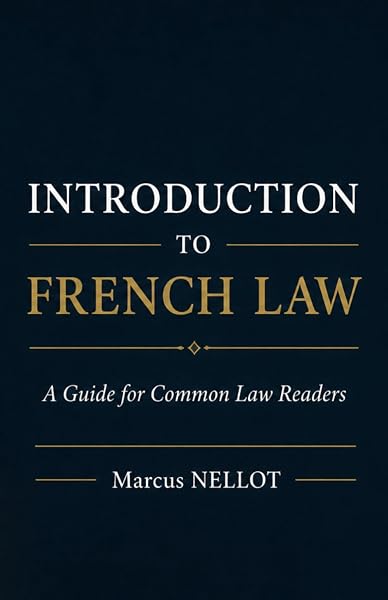
French law belongs to a family of legal systems whose ancestry runs not through medieval England but through ancient Rome, medieval Bologna and revolutionary Paris. To the common law reader, much of it will look familiar in its broad values and unfamiliar in nearly every detail. This book is written for lawyers, students, business professionals and curious readers trained in the common law tradition who wish to understand, in their own terms, the legal system that governs France and that has shaped, directly or indirectly, the private law of nearly half of humanity.
This is not a translation of a French textbook, nor an attempt to reproduce the classical pedagogy of French law faculties. It is, instead, an effort of comparative presentation. Each chapter explains French institutions and doctrines as a visitor from England, the United States, Canada, Australia, India or Singapore would want them explained — by reference to what the reader already knows, with patient attention to the points where common law intuitions will mislead, and with constant reference to comparable Anglo-American doctrines.
Across thirteen chapters and a substantive conclusion, the book maps the architecture of French legal thought. It opens with a presentation of the civil law tradition and the place French law occupies within it, before tracing the long historical arc that runs from the Twelve Tables and Justinian's Corpus Juris Civilis to the Napoleonic codification of 1804 and the contemporary constitutional reforms that introduced the question prioritaire de constitutionnalité. It examines in turn the sources of French law and their hierarchy, the foundational distinction between public and private law, the dual structure of the French court system, the characteristic methods of legal reasoning and the distinctive role of the French judge, before treating in depth the principal substantive areas: contract law, civil liability, property and persons, criminal law and procedure. Two further chapters address the legal professions and the increasingly central place of European law in French practice, including the impact of the European Convention on Human Rights and of European Union law. A chapter on fundamental rights closes the substantive exposition.
Throughout, the book draws explicit comparisons that will resonate with the common law reader. Why does French contract law function without consideration? How does the strict liability of Jand'heur compare with Rylands v Fletcher? Why are French judgments so much shorter than their common law counterparts, and what interpretive work lies beneath their compressed surface? What is a juge d'instruction, and why has the institution no real Anglo-American equivalent? What does it mean for an entire body of administrative law to be developed not by parliament but by the Conseil d'État over nearly two centuries? Each chapter takes up such questions methodically, situating French solutions within the broader comparative landscape.
The author is a practising lawyer at the Strasbourg Bar, holder of a doctorate from the University of Strasbourg, with professional experience at the Council of Europe and the International Criminal Court at The Hague. The exposition draws on this dual practical and academic background to offer an introduction that is at once technically precise and pedagogically accessible.
The book does not pretend to make its reader a French lawyer — that requires years of formation no single volume can replace. Its purpose is more modest and more useful: to equip the reader with the vocabulary, the institutional landmarks and the basic mental reflexes needed to read French legal materials with understanding, follow French legal debates with sympathy, and work with French lawyers without perpetual misunderstanding.